
Set Aside
Learning Through Building a Lovable App

There’s a lot to admire about Lovable: the accessibility, the speed of turning ideas into reality, and the community around it. But what truly stands out is the guided, transparent way it invites you to learn while building. It makes going under the hood of software feel natural, not intimidating.
When you create something personal and let curiosity lead the way, learning becomes a quiet, focused pleasure: unhurried, deeply absorbing, and genuinely enjoyable. Thoughtful, friendly conversations with the platform make it easy to ask even the most naïve questions, turning everything from backend integrations and security pitfalls to Edge Functions, cron secrets, and visual aesthetics into meaningful lessons.
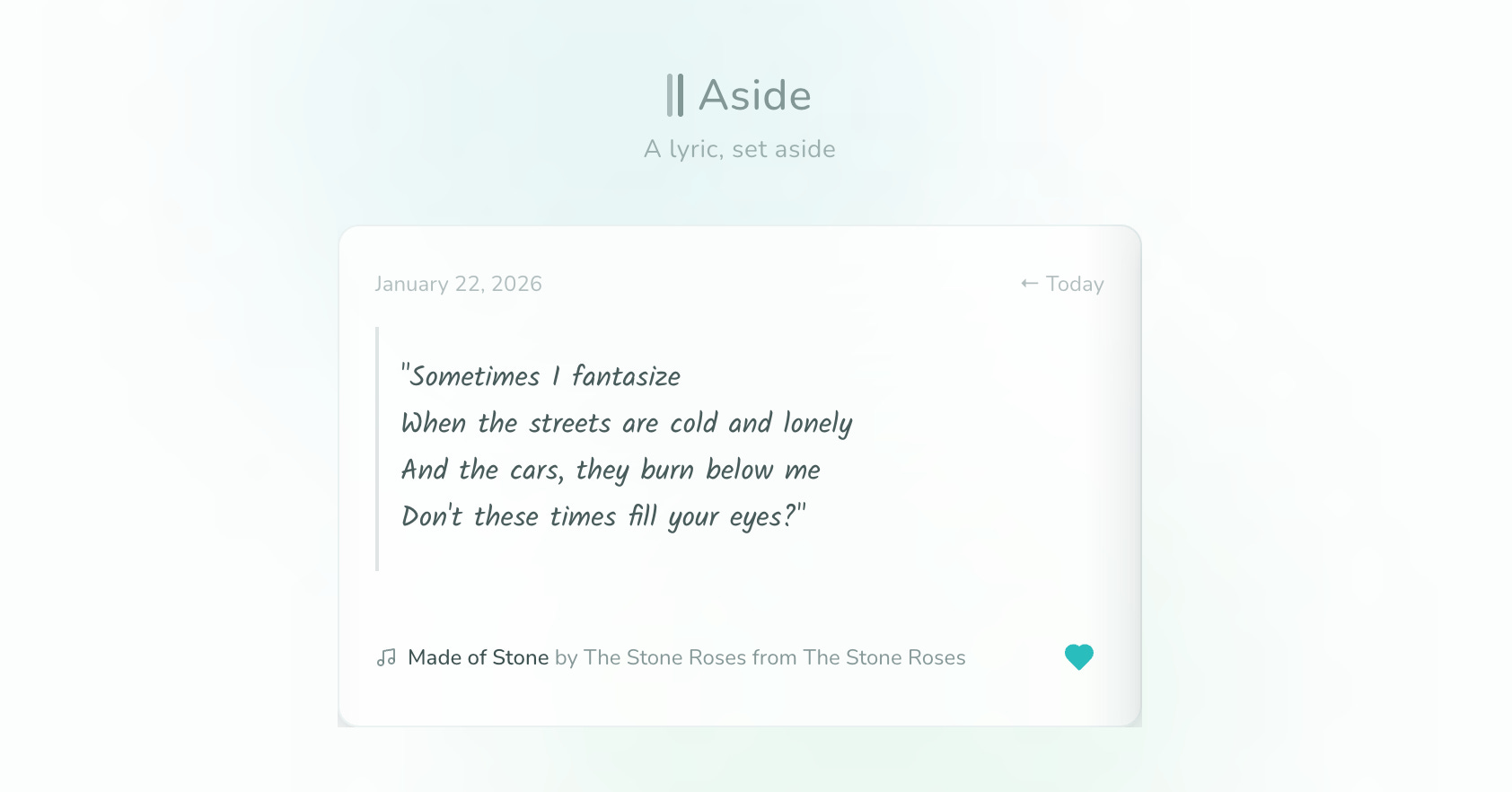
I built myself an app around a simple, quiet ritual: receiving one lyric a day. A lightweight, aesthetically minimal space that revives a small, personal habit - a single line to gently spark the day. There’s no signup, no full-song playback, no endless scrolling, just one lyric, elegantly presented, each day.
And yet, within that simplicity, I touched nearly every part of building a real product: data modeling, integrations, scheduling, edge cases, and failure modes. This wasn’t about shipping, metrics, or validating an idea. It was about building something personal, purely for pleasure and discovering how much deeper learning happens when the stakes are low.
Aside: Designing for a Moment, Not for Engagement
I’ve always trusted small creative sparks: a single line, a short prompt, a subtle nudge that quietly shifts your mood.
For years, I’ve admired Oblique Strategies by Brian Eno and Peter Schmidt, tiny cards with cryptic, occasionally challenging suggestions that can ignite fresh creativity from just one line. Music does this even better. The first song you hear in the morning can set the rhythm for the day, or even the version of yourself you show up as.
So when I found myself with a free Sunday afternoon and enough Lovable credits to experiment, it felt like an invitation: to create a daily spark. Small. Musical. Set aside.
That became Aside, designed for anyone who cherishes the emotions lyrics can evoke, enjoys quiet daily rituals like journaling or pausing to reflect, or simply wants a serene experience without clutter or distraction.
The full project lives on Lovable: code, structure and decisions included.
→ Explore the Aside project on Lovable
Learning from a Small, Intentional Project
Because the app stayed intentionally small, every part of the build remained visible and approachable. There was space to slow down, go deeper, and truly understand how things worked.
At the same time, Lovable introduced its more intelligent engine and Plan mode, laying out each feature and code change with clear, thoughtful explanations. Out of this process, three foundational concepts emerged, familiar to almost any app, yet unusually rewarding to explore this way.
Integrations - Choosing What Not to Build
Possible options
Every integration starts with a familiar dilemma: build or buy. For Aside, that question surfaced around lyrics. With enough effort, I could have assembled a small lyrics database myself. But lyrics live in a complicated space, shaped by licensing, royalties, attribution rules, and usage rights. Even for a tiny app, this made “rolling my own” less appealing than learning what already exists and how those services are meant to be used.
Best practices
Public APIs expect to be treated politely: proper headers are often required. Failures are normal and should be handled gracefully, not treated as edge cases. Results are rarely perfect: duplicates, partial matches, or unexpected formats are part of the deal. Most importantly, integrations should be abstracted. Locking your product to a single provider early on makes future changes harder than they need to be.
My solution
Aside uses LRCLIB, a free, open API that requires no API key. Requests include a proper User-Agent header, and the integration is defensive by default: if an exact match returns a 404, the system falls back to a broader search. Duplicate results are filtered out to avoid serving multiple versions of the same song.
The architecture anticipates change. A modular LyricsProvider interface keeps the app flexible, making it possible to switch to a licensed service like Musixmatch if the product ever grows commercially. Error handling, clean abstractions, and respectful API usage turned this small feature into a surprisingly rich learning space, one that mirrors challenges found in far larger systems.
Lovable Documentation:
API-integration - API-integration and Network management
Secrets Management - Storing API keys securely
Notifications - Designing a Gentle Nudge
Possible options
For a daily lyric, notifications could have taken many forms: emails, in-app reminders, calendar events, or full-blown push. Each comes with trade-offs in intrusiveness, reliability and complexity. Push notifications are powerful but can easily become loud, frequent and attention-seeking.
Best practices
Notifications should always be opt-in. Browser support must be checked ('PushManager' in window) and permission denial handled gracefully. Stale subscriptions need cleanup or you risk sending requests into the void. Security matters: anything that triggers notifications should be tightly restricted.
My solution
In Aside, notifications are part of a daily ritual, not a call to action. The copy is soft and poetic - “A line for your Tuesday” or “Something for the weekend”. The opt-in prompt appears only after a small signal of engagement, keeping the experience respectful and unhurried.
Under the hood, it uses VAPID-based Web Push with browser-generated keys stored anonymously in a push_subscriptions table. Delivery is timezone-aware: an hourly cron job triggers an edge function matching the current UTC hour against each user’s preferred hour and timezone. The send-notification function only accepts calls from internal cron jobs, verified via an X-Cron-Secret header. Invalid subscriptions (410 Gone) are automatically cleaned up.
Lovable Documentation:
Database & Scheduling - Managing push_subscriptions and cron jobs
Edge Functions - Serverless backend function
Aesthetics & Fonts - Letting the Content Breathe
Possible options
Minimal apps often fall into two traps: over-designing or under-thinking typography. With a text-driven app like Aside, the interface had to step back and let the words speak. Fewer components, fewer colors, and deliberate font choices were essential.
Best practices
For small, content-first interfaces, restraint pays off. Limit active typefaces to 2–3 maximum. Use hierarchy through weight, spacing, and opacity rather than multiple fonts. Muted contrasts often communicate more than bold visual gestures.
My solution
Aside’s visual identity treats the lyric as the hero. Nunito handles UI elements, offering warmth and readability without drawing attention. Kalam, a handwritten font, is reserved exclusively for lyric quotes, giving them an intimate, personal tone, almost like a note left just for you.
The result is a calm, literary aesthetic where content breathes. Exploring font pairings this way was unexpectedly educational: it’s not just typography, but how small visual decisions shape how software feels to spend time with.
Lovable Documentation:
Frontend-development - Custom fonts in tailwind.config.ts
Custom Fonts Guide - Adding Google Fonts and managing typography
Learning, Low Stakes and Companions Along the Way
Building Aside showed how much learning can emerge from a small, personal project. With low stakes and a deliberately tiny scope, nearly every aspect of software development surfaced. This included technical implementations as well as thoughtful product choices, like intentionally giving up personalization. Each choice became a lesson, and every experiment felt purposeful.
Lovable’s platform guided me through technical and design decisions, challenged assumptions, and offered clear explanations to even my simplest questions. My ChatGPT agent provided thoughtful conversations that helped me reason through trade-offs, explore alternatives, and reflect at every step. Together, they turned a personal project into a rich learning experience I wouldn’t have anticipated.
Ultimately, the most rewarding lesson isn’t technical at all: learning is at its deepest when curiosity drives the work and the pressure is low.
What are you building, exploring, or vibe coding in your own quiet corner and what surprising lessons have you discovered along the way?